|









Home
Up |
|
Publications
Books:
|

|
Bookmapping, Lit Trips and Beyond
By Terence Cavanaugh and Jerome Burg from ISTE press.
With books, your students can travel the world―exploring faraway places and meeting people from different cultures. With bookmapping, they can use technology to virtually expand their understanding of the locations they visit and connect literature with geography, social studies, and more. Bookmapping allows students to plot the locations of a story on an interactive map, adding multimedia and hyperlinks about the setting, characters, and plot. They can add a photograph of a historical figure or an audio clip of regional music. And maps offer much more, helping students see places in the book up close―the vastness of the ocean their hero must cross, or the density of a city that hosts colorful and varied characters.
In Bookmapping: Lit Trips and Beyond, Cavanaugh and Burg show you how this dynamic, interactive activity is a cross-curricular tool that helps students not only develop a better understanding of places, cultures, and the books they are reading, but also make connections among the subjects they learn in school. The authors explain how to create bookmaps, how to use existing ones, how to use them for creative writing, and much more. In addition, they provide instructions for mapping programs including Google Earth, share a few sample lesson plans, and discuss classroom management so you can start bookmapping whether you have one computer in your classroom or a computer for every student.
|
|
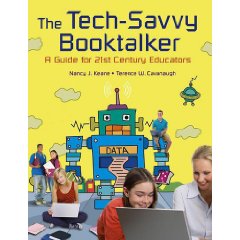
|
Tech-Savvy Booktalker: A Guide for 21st Century Educators
Nancy Keane and Terence Cavanaugh from Libraries Unlimited
Booktalks, booktalks, or booktalking, are the process creating short "commercials" about books which are presented by librarians, teachers, or students in elementary through high schools, libraries, or even people just get together, way to entice others to read a book. The Tech-Savvy Booktalker is designed for educators (k-12), technology support persons, media specialists, special education personnel, and reading/literacy instructors/coaches, this educator's guide is a combination reference, strategy guide, and tutorial for teachers about integrating, enhancing, and supporting booktalking with technology. The book provides strategies, instructions, and ideas for using booktalks as teaching and learning tools at all grade levels and in all content areas. Included are instructions for making digital booktalks to use with students, instructions for using existing school technology to create booktalks, and applications for using digital booktalks within the classroom and media center. Available from Libraries Unlimited and from Amazon.com.
Some more resources & information on booktalking: http://www.drscavanaugh.org/booktalk/booktalk_technology.htm and Nancy Keane's Booktalks -- Quick and Simple (over 5000 ready-to-use booktalks for children in Grades K-12) |
 |
Literature Circles Through Technology by Terence Cavanaugh (2006). by Terence Cavanaugh (2006).
Linworth Publications.
This educator's guide is a combination reference, strategy guide, and tutorial for enhancing literature circles with technology, from the use of eBooks as the reading source to implementing a successful literature circle in an interactive online environment. This book provides background information about the literature circle along with technology integration strategies, instructions, ideas, and student worksheets in all content areas. Includes descriptions of various free online electronic book resources, instructions for using existing school technology as part of literature circles, and methods for using literature circles in an online environment. Available from Amazon.com |
 |
The Digital Reader: Using EBooks in K-12 Education by Terence Cavanaugh (2005)
ISTE Press.
The rapidly increasing availability and low cost of e-book technology makes it ideal for schools and educators looking to expand their resources for readers. This book introduces the unique features that have established e-books as a powerful, effective learning tool for all grade levels and for special needs students. The book includes descriptions and illustrations of the most popular e-book platforms and programs, as well as dozens of practical ideas for using e-books for reading instruction, personal productivity, and curricular enrichment. Brimming with interactive lesson ideas, teaching tips, and online resources, this book is a must-have for teachers in all content areas and library media specialists. Available from ISTE Bookstore and Amazon.com.
Table of Contents | Chapter Excerpts |
 |
Teaching Science with Science Fiction Films: a Guide for Teachers and Media Specialists 2nd Edition, by Terence Cavanaugh and Cathy Cavanaugh (2004).
Linworth Publications
This book utilizes science fiction films to teach science skills and concepts. Its hands-on, interactive lessons will keep students engaged and excited about learning! As a tool for use in grades 5-12, both students and teachers alike will find numerous uses for the ideas and lessons inside. It is a stand-alone resource in covering all the areas of science with science fiction films. And educators will find that it is essential in structuring a science curriculum with the multimedia tools that keeps students engaged in today’s information age. Infused with information literacy standards and national content standards, Teach Science with Science Fiction Films presents 25 teaching modules covering ten major science areas. Easily incorporated into interdisciplinary curricula from grades five through high school, each module includes teacher information, questions related to video content, discussion questions, projects, and science vocabulary. Each teaching module also includes hands-on laboratory activities designed to strengthen student understanding of concepts addressed in films. The book’s approach has been awarded National Science Teachers Association awards for exemplary science teaching using a variety of popular films and television episodes. This book is perfect for use by upper elementary to high school science teachers as well as media specialists seeking an ideal collaboration tool within the science curriculum. Available from Amazon.com |
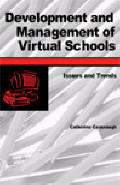 |
Book Chapter: Distance learning as a form of accommodation, in Cavanaugh, C., Ed. 2004. Development and Management of Virtual Schools: Issues and Trends . Hershey, PA: Idea Group Publishing.
Virtual schools are a result of widespread changes in knowledge about learning, in available technology and in society. Virtual schooling is growing in popularity and will continue to attract students because of the benefits it offers over traditional schooling. Stakeholders in virtual schools need information to guide their decisions. For the foreseeable future, virtual schools will continue to meet diverse student needs, and to evolve in response to further change. Development and Management of Virtual Schools: Issues and Trends brings together knowledge of virtual schools as a reference for scholars and other groups involved in virtual schools. The chapters review best practice from concept and development, through implementation and evaluation. Available from Amazon.com |
| |
|
Chapters:
Cavanaugh, T. 2005. Online Learning as a Form of Accommodation chapter in the Encyclopedia of Information Science and Technology, Edited by Mehdi Khosrow-Pour, D.B.A., Idea Group Inc. Hershey, PA.
Cavanaugh, T. 2004. Distance Learning as a Form of Accommodation chapter in Development and Management of Virtual Schools: Issues and Trends. Edited by Cathy Cavanaugh, Idea Group, Inc. Hershey, PA.
Articles
Cavanaugh, T. 2005. “Technology and the Read Aloud.” Florida Reading Quarterly V41 N2 pp. 2005.
Cavanaugh, T. 2005. EBooks: Expanding the School Library. Library Media Connection. Linworth Publications. February 2005. pp 56-59.
Cavanaugh, C. 2004. "Distance Learning Success Factors in the Resources-Processes-Results Cycle and Virtual School Accreditation" in Development and Management of Virtual Schools: Issues and Trends. Hershey, PA: Idea Group Publishing.
Cavanaugh, T. 2004. "Online Picture Books - Reading Resources for all Ages and Classes." Florida Reading Quarterly V40 N3 pp. 32-35.
Cavanaugh, T. 2003. "Using MS Word to Support Reading." Florida Reading Quarterly V40 N2 pp. 30-32.
Cavanaugh, T. 2003. Talking with a Computer: Text-to-Speech & Speech-To-Text—Applications Across Abilities and Grade Levels. Spring 2003 issue of Library Media Connection
Cavanaugh, T. & Cavanaugh, C. 2002. eBooks for Education, Computers in the Social Studies Journal Volume 10 Number 2, April/June 2002. (Reprinted from the proceedings of SITE 2002)
Cavanaugh, T. & Cavanaugh, C. 2002. Web Page Evaluation for Education, Computers in the Social Studies Journal Volume 10 Number 2, April/June 2002. (Reprinted from the proceedings of WebNet 2001)
Cavanaugh, T. 2002. . TEACHING Exceptional Children. VOL. 35 NO.2 NOV/DEC 2002
Cavanaugh, T. 2002. Assistive Technology: Tools to Improve Instruction. Florida Educational Leadership. Fall 2002, Volume 3, Number 1.
Cavanaugh, T. 2002. Educational Technology Review (ETR), Vol. 10, No. 1, 2002 (http://www.aace.org/pubs/etr/cavanaugh.cfm)
Cavanaugh, T. & Cavanaugh, C. 1996. Learning Science with Science Fiction Film. Kendall-Hunt.
 |
"Distance Learning Pedagogy: A Staff Development Series for Faculty",
"Web Page Evaluation for Education", paper published in the proceedings of WebNet 2001. |
|
"An Introduction to Assistive Technology Online" presented at International Conference on Higher Education Teaching and Learning (ICHETL), April 2001, Jacksonville FL. |
|
Author of “The Need for Assistive Technology in Educational Technology” (Best Paper in Special Education category award)
Co-author of "Standards of Practice Online Workshop"
Co-author of "Comparison of face-to-face and online instruction for introduction to educational technology courses for educators"
Co-author of "Effective Presentation Design" presented at SITE Orlando, March 2001. |
|
“Developing A Dual Enrollment Course In Educational Technology” Published in the proceedings of Florida Professional Development Schools (PDS) Colloquium, Tampa, FL, 2000 |
|
“Technology on a Tight Budget” Teachers of English for Speakers of Other Languages (TESOL) Messenger, Spring 2000
|
|
“Interactive PowerPoints” (author)
”Developing a College Course on School Networks”(co-author)
published in the proceedings of National Educational Computing Conference (NECC), Atlanta, GA, 2000.
|
|
“Prospectus for an Online Assistive Technology Class” (author)
“On-line Forum for Preservice Educators” (co-author)
Publication in the proceedings of WebNet, San Antonio, TX, 2000
|
|
“Developing a School Networks Course” (co-author) published in the proceedings of the Society of Information Technology and Teacher Education (SITE), San Diego, CA, 2000
|
|
“Interactive PowerPoint for Education” published in the proceedings of Society for Information Technology and Teacher Education (SITE), San Diego, CA, 2000.
|
|
“Digital Cameras for Math and Science” (co-author) published in the proceedings of Math Science Education and Technology (MSET), San Diego, CA, 2000.
|
|
“Web Enhanced Professional Development for Educators” published in the proceedings of WebNet, Hawaii, 1999.
|
|
“Standards and Instructional Tools via Web and CD” (co-author)
|
|
“Effects of Using Repurposed Science Rich Feature Film in Middle Grades Science” (author) published in the proceedings of Instruction International Conference on Technology in Education (ICTE), Tampa, FL, 1999.
|
|
“Baking a Magnetic Field Display” (co-author) in The Physics Teacher, February, 1998.
|
|
“Digital Cameras in Education,” presented at the International Conference for Technology in Education in Oslo, Norway, 1997.
|
|
“Alginate Option Letter” in Journal of Geologic Education, October, 1997.
|
|
“Educational Applications for Digital Cameras” (co-author) in Technology Connection, November. 1997
|
|
“Shake and Bake Magnetic Fields” (co-author) in Science Scope, November. 1997
|
|
“Digital Cameras, Ready, Aim,, Click” (co-author) in MultiMedia Schools, October. 1997
|
|
Digital Camera Training Guide for Education (co-author), Casio, 1996
|
|
Technology Laboratory Middle School Modules, Collier County
Telecommunications, 1994
Weather Technology, 1994
WWW Homepage, 1995
|
|
Science Project Handbook (co-author), Collier County Public Schools 1993, 1995, 1997
|
|
Teaching Science with Science Fiction Films. (co-author) Kendall/Hunt, 1994
|
|
U.S. Department of Energy Publications:
Soda Bottle Hydrology 1993 (author)
Risk Assessment and Energy Choices 1994 (co-author)
Recycle Game 1994 (co-author)
Waste-To-Energy Laboratory 1994 (co-author)
An Exercise in Using the U.S. EPA's Hazard Ranking System 1994 (co-author)
Transporting Radioactive Waste: An Engineering Activity 1994 (co-author)
|
|